Protests took place in Tel Aviv, Jerusalem, Haifa, and Beersheba, as a survey found broad but uneven support among Jewish Israelis for Operation Roaring Lion.
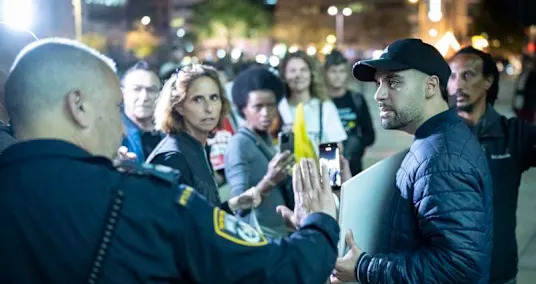
Israel Police arrested 21 anti-war protesters Saturday night as demonstrations against the conflict with Iran expanded in multiple cities despite restrictions on public gatherings.
Protests took place in Tel Aviv, Jerusalem, Haifa, and Beersheba, with hundreds of participants reported in Tel Aviv and Jerusalem and about 100 in Haifa, marking the largest turnout since weekly demonstrations began. Authorities said 13 people were arrested in Tel Aviv and eight in Haifa.
Police said the gatherings were not approved under Home Front Command regulations that ban events with more than 50 people. Officials said the increase in turnout followed calls by groups opposing the government to protest despite the restrictions.
“During a situation assessment that took place at the scene with a Home Front Command representative… it was clarified that there was a real risk to human life and accordingly, Yarkon [precinct] police commander Tzachi Sharabi ordered the gathering to be dispersed,” police said.
Hadash-Ta’al chairman Ayman Odeh, an Arab lawmaker involved in the protests, criticized the police response, calling officers fascists “in the service of the government” and saying they were afraid of “the heroic citizens who went out, despite everything, to make their voice heard.”

Survey shows broad, uneven support for war
The demonstrations come as a March 2026 survey by the Israel Democracy Institute found broad but uneven support among Jewish Israelis for Operation Roaring Lion. Support was strongest on the Right at 87% and about half on the Left.
The survey also found that Jewish and Arab respondents largely agreed that Iran’s resilience has been stronger than expected. Most Jewish respondents said Israeli society could sustain the campaign for up to one month, while 28% said as long as needed. Arab respondents were less optimistic about how long the public could endure the conflict.
A majority of Jewish respondents said Prime Minister Benjamin Netanyahu’s decision was driven by security considerations, while most Arab respondents viewed it as political.
LATEST POSTS
- 1
 Day to day Temporary Positions That Compensate Fairly in the US
 - 2Vote In favor of Your Favored IT Administration
- 3Israel says soldiers wounded in Gaza fighting amid fragile truce
- 4Gen Z workplace stereotypes were TV’s favorite punchline in 2025
- 56 Arranging Administrations to Change Your Open air Space


- Defense Minister Katz moves to extend IDF service to 36 months
- The Latest: Fueling begins as NASA aims to send 1st crew to the moon in 53 years
- The Significance of Prenuptial Arrangements in Separation Procedures
- Watch Rocket Lab launch Japanese technology-demonstrating satellite to orbit tonight
- ByHeart infant formula recall tied to botulism outbreak puts parents on edge
- NATO needs Ukraine's 'adaptation DNA' and an 'HOV lane' for new war tech, top commander says
- I binged all 24 Hallmark Christmas movies in less than 30 days. I emerged a changed man.
- Iran Used $2 Billion in Crypto to Run Its Militant Proxies in 2025
- Israel Police decry online defamation campaign against female officer in Jerusalem