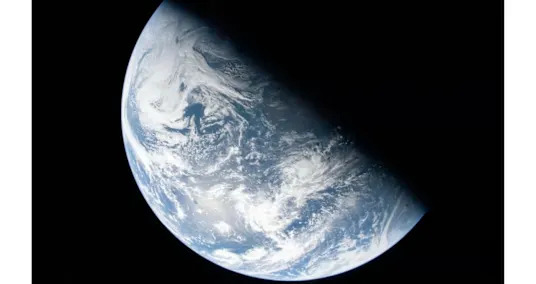
Following winter storms that lashed California with rain and snow in recent weeks, the state is completely free of drought for the first time in 25 years, according to the U.S. Drought Monitor.
The last time California had no regions considered “abnormally dry” or in drought conditions was in December 2000.
The state’s drought-free status is welcome news for water managers, but residents in some regions are still recovering from a series of punishing atmospheric river storms that brought intense rain and flooding. Areas in higher elevations, meanwhile, have contended with heavy snow and risk of avalanches.
Over the course of about a week beginning Dec. 20, parts of Northern California received up to 7 inches of precipitation, while up to 4 inches fell in southern parts of the state. Then, as New Year’s Day approached, the state was hit once more with several rounds of heavy rain and flooding. Together, the events pushed California’s 17 major reservoirs to 129% of their average levels, according to state records.

The wet winter has boosted California’s snowpack, which is crucial to its water supply, though the snowpack is still lower than average. The California Department of Water Resources said at the end of December that readings from 130 monitoring stations throughout the Sierra Nevada indicated a statewide snow-water equivalent (a measure of the amount of water in the snowpack) of 6.5 inches, which is 71% of the average for this time of year.
Officials remain hopeful, however, given that California’s biggest snow producing months are typically January, February and March.
“It is still early in the season and our state’s water supply for this year will ultimately depend on a continued cadence of storms throughout winter and early spring,” Angelique Fabbiani-Leon, state hydrometerologist for the Department of Water Resources, said in a statement Dec. 30.
The Sierra Nevada snowpack usually supplies around 30% of California’s yearly water needs.
Unlike California, other parts of the West — including Nevada, Utah and Colorado — are grappling with persistent dry conditions and snow levels that are far below usual.
Snowpack in Utah is at record lows, with 93% of the state currently in drought conditions, according to the Utah Division of Water Resources.
In Washington, Oregon, Colorado, Arizona and New Mexico, more than 80% of monitoring stations are recording a “snow drought,” according to the National Oceanic and Atmospheric Administration’s National Integrated Drought Information System. The term refers to snow-water equivalent readings that fall below the 20th percentile.
This article was originally published on NBCNews.com
LATEST POSTS
- 1
 New movies to watch this weekend: See 'We Bury the Dead' in theaters, rent 'Wicked: For Good,' stream 'The Unbreakable Boy' on Starz
 - 2Traveling Alone: An Excursion of Self-Disclosure
- 3Big majority in Germany call Berlin's efforts on gas prices too weak
- 4The most effective method to Pick the Right Material Organization: Your Definitive Aide
- 5The wolf supermoon will kick off 2026 with a celestial bang. Here's when and how to see it.




- California warns of death cap mushrooms outbreak resulting in 3 deaths
- Startled Venezuelans express relief but also fear after Maduro arrest
- It's official: NASA's Artemis 2 moon mission will break humanity's all-time distance record
- Ski Resorts Universally: A Colder time of year Wonderland Guide
- 'Malcolm in the Middle' reboot releases 1st trailer, reuniting Frankie Muniz and Bryan Cranston: Watch here
- IDF strikes Hamas terror cell operating near Israeli troops in northern Gaza
- From record warming to rusting rivers, 2025 Arctic Report Card shows a region transforming faster than expected
- Mojtaba Khamenei unconscious in Qom, not actually running Iran
- Two Israeli infants among wounded by shrapnel in overnight Iranian missile barrage