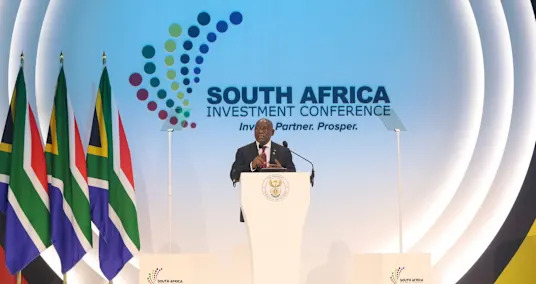
South African President Cyril Ramaphosa launched a nearly $200 billion investment drive aimed at accelerating economic recovery and industrialization in the face of growing worry over the impact of the Iran war on the continent’s biggest economy.
For more than a decade, South Africa’s economy has barely grown, leaving it with crumbling infrastructure and the need to create jobs in a country where one in three people are unemployed. Ramaphosa’s pitch to investors in Johannesburg this week was that South Africa has fixed the worst bottlenecks: He said the country is opening key sectors to private capital and is ready for large scale investments.
Ramaphosa said the effort will run through 2030 with delegates at the South African Investment Conference pledging $53 billion across 31 projects spanning energy, logistics, manufacturing, and digital infrastructure. They include Coca-Cola’s $1 billion expansion plan, and a $3.6 billion commitment from Sasol — the world’s biggest maker of fuel from coal — to upgrade operations.
LATEST POSTS
- 1
 What is colostrum? And should you be taking it?
 - 2The Most Astonishing Arising Advancements to Watch
- 3Artemis II astronauts will see parts of the moon no human has before. Here’s how
- 4The Benefits of Effective money management for Your Youngsters' Future Monetary Prosperity
- 5Here's how 'Bridgerton' fans can watch the first episode of Season 4 before its Netflix release later this month





- Decrease in Home Buy Credits and Home loan Renegotiating Rates: An Outline of Latest things
- South African army arrive in crime hotspots to help tackle gangs
- A definitive Manual for 2024's Most In vogue Wedding Dresses
- Russia patents space station designed to generate artificial gravity
- Gunmen open fire near Israeli consulate in Istanbul in possible ISIS-linked attack
- Which Store is Your Decision ?
- Becoming amazing at Systems administration: Individual and Expert Tips
- Airbnb Unveils Airport Pickup Service Across 125 Cities in Global Expansion
- Vote in favor of your #1 Kind of Cap