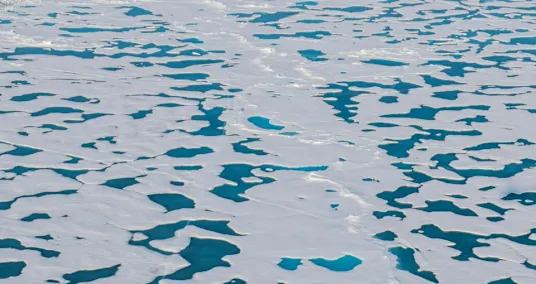
Right now, the Arctic is maxing out on sea ice – the cold of winter has built up over months of darkness, and ice has spread as far south as it will all year. It’s the North Pole’s sea ice maximum, except this year, it’s alarmingly low.
There is roughly half a million square miles of ice missing in this year’s “max,” compared to average — an amount twice the size of Texas.
It’s the latest profoundly worrying signal from the top of the planet, a region which has become a clear victim of the climate crisis as humans burn fossil fuels, and increasingly a geopolitical hotspot as melting ice opens up commercial and military opportunities.
Winter is when Arctic ice builds up, typically reaching its maximum extent in March. This year, when scientists from NASA and the National Snow and Ice Data Center measured it on March 15, they found the ice had reached 5.52 million square miles — roughly 9% lower than the average between 1981 and 2010.
It came in just below last year’s record maximum of 5.53 million square miles, but close enough to it that it’s technically a tie, and is the lowest peak observed since satellite records began in 1979.
“A low year or two don’t necessarily mean much by themselves,” said Walt Meier, a NSIDC ice scientist, but when looked at in the context of a multi-decade downward trajectory, “it reinforces the dramatic change to Arctic sea ice throughout all seasons.”
Scientists are concerned about what it will mean for the spring and summer melt season. The last 19 years have seen the lowest sea ice levels on record.
The Arctic will be ice-free in the summer at some point by 2050, even if humans stop pumping out climate pollution, according to a 2023 study.
Disappearing sea ice has global impacts. Ice acts like a giant mirror, reflecting the sunlight away from the Earth and back into space. As it shrinks, more of the sun’s energy is absorbed by the dark ocean, which accelerates global heating.
This new record is not a surprise as Arctic sea ice had been running at near record lows all winter, said Jennifer Francis, a senior scientist at Woodwell Climate Research Center. But it’s one more alarm bell.
“Like when a person’s blood pressure is out of whack signaling a health problem, the ongoing loss of sea ice is yet another symptom indicating the Earth’s climate is in big trouble,” she said.
The cause is no mystery she added, “the ongoing buildup of heat-trapping gases in the atmosphere from burning fossil fuels is warming the oceans, heating the air, melting the ice, and worsening weather extremes all around the world.”
For more CNN news and newsletters create an account at CNN.com
LATEST POSTS
- 1
 Florence's Uffizi Gallery moves treasures to safety after cyberattack
 - 2An 'explosion' of solo-agers are struggling with rising costs and little support: 'I'm flying without a net'
- 3High Court freezes government move to shutter Army Radio pending ruling
- 4Israel and Lebanon's Hezbollah continue to trade attacks
- 5Which Breakfast Enraptures Your Taste Buds? Vote





- Doctored NXT Summit footage falsely portrays Modi as declaring war on Iran and Pakistan
- Explosions at Burundi ammunition depot kill civilians, witnesses say
- Why do people get headaches and migraines? A child neurologist explains the science of head pain and how to treat it
- Find the Interesting Universe of Computerized reasoning: the Capability of man-made intelligence
- Kids may be more likely to get the new ‘Cicada’ variant of Covid-19, scientists say. Here’s what to know about BA.3.2
- Getting through a Lifelong Change: Individual Examples of overcoming adversity
- Viable Monetary Tips to Advance Your Monetary Circumstance
- the Wild in Style: The Reduced Portage Mustang's Bold Heritage
- Couch Styles of 2024: What's Moving