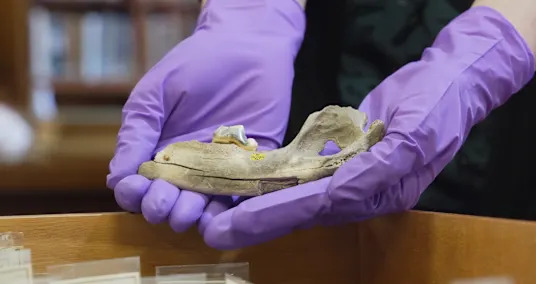
WASHINGTON, March 25 (Reuters) - Dogs have been loyal companions to people since we made them our first domesticated animals, descending long ago from gray wolves - though precisely when, where and why have remained unanswered. New genetic research now is offering valuable insight, including identifying the earliest-known dog, dating to 15,800 years ago.
This dog, known from bones found at the Pinarbasi rock shelter site in Turkey used by ancient human hunter-gatherers, is about 5,000 years older than the previous earliest-known, genetically confirmed canine, the researchers said.
The date of the Pinarbasi dog and several others almost as old identified at other sites in Europe shows that dogs already were widely distributed and an integral part of human culture millennia before the advent of agriculture, they said.
The new findings were presented in two scientific papers published on Wednesday in the journal Nature.
William Marsh, a postdoctoral researcher in the Ancient Genomics Laboratory at the Francis Crick Institute in London who was co-lead author of one of the studies, said the DNA evidence suggests dogs were present in various locales in western Eurasia by 18,000 years ago and already were quite different genetically from wolves.
"We putatively predict that dog and wolf populations diverged a lot earlier, likely before the last glacial maximum (of the Ice Age), so before 24,000 years ago. Although saying that, there is still a great degree of uncertainty," Marsh said.
The dog, descended from an ancient wolf population separate from modern wolves, was the first animal domesticated by people, with animals such as goats, sheep, cattle and cats coming later.
"Dogs have been by our side as humans underwent major lifestyle transitions and complex societies emerged," said geneticist Anders Bergström of the University of East Anglia in England, lead author of the other study.
"I think it's also interesting that, unlike most other domesticated animals, dogs do not always have very clearly defined roles or purposes for humans. Perhaps their primary role is often just to provide companionship," Bergström said.
Bergström and his team performed a large-scale search for the early dogs of Europe, using a new method to differentiate genetically between wolves and dogs among 216 ancient remains ranging from 46,000 to 2,000 years old from Belgium, Denmark, France, Germany, the Netherlands, Scotland, Sweden, Switzerland and Turkey. This was the largest study of such remains to date.
The researchers managed to identify 46 dogs and 95 wolves. Because the skeletons of dogs and wolves were so similar in the early stages of canine domestication, genetic studies are needed to distinguish between them in ancient remains.
The oldest of the dogs identified by Bergström's team was one dating to 14,200 years ago from Switzerland's Kesslerloch Cave site. The oldest of the European dogs identified in this study were found to have shared an origin with dogs in Asia and the rest of the world, showing that these various canine populations did not arise from separate domestication events.
The Pinarbasi dog, identified in the study Marsh worked on, showed how much dogs were valued by the hunter-gatherers who kept them.
"At Pinarbasi, we have both human and dog burials, with dogs buried alongside humans," Marsh said.
There also was evidence that the people at Pinarbasi fed their dogs fish.
This study identified five dogs dating to between 15,800 and 14,300 years ago, including canine remains from Gough's Cave near Cheddar in England.
"At Gough's Cave, we have butchering and processing of humans after death that included cannibalism, as a funerary behavior akin to burial. Similar post-mortem modification, albeit not definitively for consumption, was found on the dog remains," Marsh said.
The Pinarbasi and Gough's Cave dogs were found to be more closely related to the ancestors of present-day European and Middle Eastern breeds such as boxers and salukis than to Arctic breeds like Siberian huskies.
Beyond companionship, the ancient dogs may have helped people hunt or perhaps served as watchdogs, sort of Ice Age alarm systems, according to the researchers. Unlike the many exotic dog breeds around today, these early dogs still likely closely resembled the wolves from which they descended, they said.
"The questions of when, where and why people domesticated dogs still remain largely unanswered," Bergström said. "We think it probably happened somewhere in Asia, but more precisely remains to be determined."
(Reporting by Will Dunham in Washington, Editing by Rosalba O'Brien)
LATEST POSTS
- 1
 Idris Elba is the king of the stress-watch
 - 2New movies to watch this weekend: See 'Predator: Badlands' in theaters, rent 'Black Phone 2,' stream Guillermo del Toro's 'Frankenstein' on Netflix
- 3Photos of amputees in Gaza, struggling to survive after losing limbs to Israeli airstrikes
- 4Director of Swiss hospital describes the rush to treat the injured from Alpine resort bar fire
- 5Figure out How to Consolidate Cutting edge innovations in Senior's SUVs


- 7 Fun Plans to Make Film Evenings Seriously Energizing (You'll Cherish #5!)
- Dr. Vinay Prasad's memo raises concerns about COVID-19 vaccines and pediatric mortality
- How 2025 became the year of comet: The rise of interstellar 3I/ATLAS, an icy Lemmon and a cosmic SWAN
- New studies of old dogs help scientists understand where they came from
- ‘This year nearly broke me as a scientist’ – US researchers reflect on how 2025’s science cuts have changed their lives
- McDonald's is bringing two 'KPop Demon Hunters' meals to McDonald's. Here's what they include and when they launch.
- German unemployment rate falls to 6.4%, but 3 million still jobless
- Careful Connections: Building Association and Trust
- James Webb Space Telescope watches 'Jekyll and Hyde' galaxy shapeshift into a cosmic monster