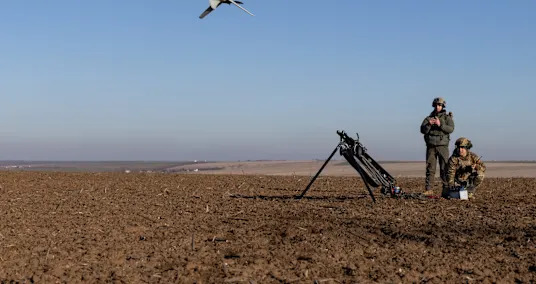
Ukraine's success with drone warfare has sparked a flurry of investments in drones by Western militaries.
Notably, though, neither Russia nor Ukraine has won the war with them.
Defense experts have said the West needs drones but must be careful to avoid overreliance.
Drones are everywhere in Ukraine — hunting tanks, guiding artillery, and killing soldiers in staggering numbers. These weapons have reshaped how the war is fought, but they haven't decided it.
Drone warfare in Ukraine is a survival tactic in a bloody slog, not necessarily a tool for victory. Defense experts argue that heavy drone usage in this war is a workaround for weak points, rather than a blueprint for decisive combat strength.
Ukraine and Russia have pushed drones to unbelievable —and once unimaginable — levels of use, but that surge reflects deep constraints.
Neither side has been able to secure lasting air superiority or deliver a decisive blow with long-range fires or coordinated combined-arms offensives. With stockpiles of more traditional weaponry under heavy strain, drones dominate, buzzing over largely static lines.
"These have not won the war for either side," said retired Air Marshal Greg Bagwell, who spent 36 years in the Royal Air Force and served as its director of joint warfare. Instead, the war is "the same static attritional land campaign" seen in World War I, he said. It grinds on with no major breakthroughs. That matters as Western nations study the drone war.
"There's a fundamental question here" for Ukraine's Western partners, Bagwell said recently at UK think tank Chatham House. "Is this the war we want to design to fight?" He assessed that what the world is seeing is a "symptom of a lack of air control over the Ukrainian front."
Ukraine has been hugely successful with drones, using them to maximum effect to fill holes in its arsenal and manpower. Ukrainian President Volodymyr Zelenskyy said this month that his country's drones cause 90% of Russian losses at the front.
But as James Patton Rogers, a drone expert at the Cornell Brooks Tech Policy Institute, previously told Business Insider, they "haven't brought victory for either side."
A different way of war in the West
The West doesn't have the same capability gaps. NATO has vast armies across the alliance, powerful air forces, and long-range strike options available, giving it flexibility with drones. It can use drones to augment its forces and to complete missions unsafe for human soldiers without needing to depend heavily on them.
Western militaries can use drones for scouting, targeting, and even striking, but that isn't the only way of war. Bagwell said that the Ukrainians have had "to adapt and fight the way they can only fight." For the West, the question is "whether that is the way we want to fight," he said.

Justin Bronk, an air power expert at the UK's Royal United Services Institute, shared similar concerns, arguing that Ukraine's "over-reliance" on drones is problematic and "not something Western militaries should attempt to replicate." That reliance has been partly driven by necessity, Bronk said, amid shortages of other weaponry.
He wrote in an August assessment that betting big on drones is a "dangerous strategy" for NATO nations. He observed that Ukraine is still suffering heavy losses and losing ground despite its status as a leader in modern drone warfare. Bronk also argued that it isn't in the alliance's best interest to play Russia's game, once it's gained tremendous experience playing in Ukraine.
"Western forces are highly unlikely to achieve transformative lethality and thus deterrent credibility against Russian forces by procuring several tens or even hundreds of thousands of similar drones more slowly and with less practical experience."
Drones can still serve a purpose within Western militaries, Bronk added, but they should be used primarily to augment combat power rather than replace traditional weaponry in their arsenals.
There has been significant hype surrounding drones as a result of this war, and not without reason, but defense experts caution against reading too much into these systems.
Stacy Pettyjohn, a senior fellow and the director of the Defense Program at the Center for a New American Security, wrote just over two years ago that "while tactical innovation abounds and drones offer some new capabilities, their impact falls short of the truly disruptive change that constitutes a so-called revolution in military affairs." That said, they are having transformative effects.
"Drones alone will not determine who prevails in this conflict," she wrote, "but they will certainly play a prominent role in the ongoing war in Ukraine and in other battlefields in the future."

There are practical considerations for the West on offense and defense. Drones are becoming increasingly affordable and accessible, these systems have the capacity to complicate maneuvers, and as the technology evolves with artificial intelligence and swarm advancements, they may prove even more challenging.
"There's absolutely a fundamental rethink required," Bagwell said. "I think if you're a soldier on the battlefield, now your world has changed irreparably."
Drone programs are emerging in Western militaries to prepare troops for these shifts, but with the clarity that not every lesson from the war in Ukraine is going to be applicable.
The US Army's new drone lethality course is teaching its soldiers that drones are not always the right weapon. Maj. Rachel Martin, the course director, told Business Insider that she wants soldiers to know that "it is a tool with which to accomplish a mission, but it may not be the tool given a certain mission set."
She said the Army needs to catch up in drone warfare and views it as an important part of modern combat. But she emphasized that Ukraine's heavy reliance on drones reflects necessity, not choice — a position the US is unlikely to face given its stronger military advantages.
She said the Ukrainians are "in a fight for their lives, and they're using what they have available to them because they don't have those layered assets that we are lucky to have in our country."
Read the original article on Business Insider
LATEST POSTS
- 1
 Step by step instructions to Pick the Right Dental specialist for Your Dental Inserts Technique
 - 2Trial of pro-Palestine activist begins
- 3Is Chinese food truly flavorful?
- 4Moon fever hits DC as Artemis 2 rocket 'candle' lights up Washington Monument just 1 month before launch (photos)
- 5At least 55 injured in Russia after train crashes, overturns


- NASA's Voyager 1 set to achieve historic distance from Earth
- The Best Internet based Courses for Expertise Improvement
- The Manual for Well known rough terrain Vehicles
- See the first close-up photos of the moon from NASA's Artemis II mission
- Nestlé says 413,793 KitKat candy bars stolen en route from Italy to Poland
- NASA loses contact with its Maven spacecraft orbiting Mars for the past decade
- The Best 15 Applications for Efficiency and Association
- Opening Achievement: 8 Methodologies for Compelling Using time productively
- Focus on Yourself: Wellbeing and Taking care of oneself Practices