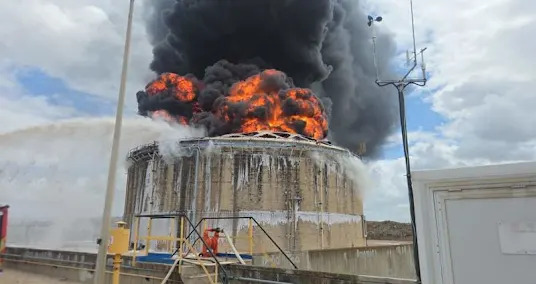
The ship, a Marshall Islands-flagged tanker named Talara, is not the first ship the IRGC has hijacked, but it had stepped back from such threats recently.
Iran has taken credit for seizing a ship on Friday that was off the coast of the UAE near the Strait of Hormuz.
“Iran’s Islamic Revolution Guards Corps (IRGC) Navy has seized an oil tanker off the southern coast of Makran under a judicial order over violations by the vessel,” Iranian state media IRNA said, revealing details about the takeover.
The IRGC Navy had monitored the ship, which was a Marshall Islands-flagged tanker named Talara.
The IRGC has its own naval vessels, mostly small fast boats. The relatively small Iranian navy has several other larger ships. The IRGC is often involved in Iran’s naval actions in the Persian Gulf and the Gulf of Oman. It has hijacked many vessels in the past. It increased those operations back in 2019, confiscating several ships.
However, Iran has appeared to step back from these threats recently.

What do we know about the Iranian decision to redirect this ship toward Iranian waters?
The IRGC Navy said the “operation was carried out in line with legal duties and to protect the national interests and resources of the Islamic Republic of Iran.”
The IRGC sent vessels to follow the Talara in the first hours of Friday “after [an Iranian] court ordered the seizure of the vessel.”
Tehran claimed that the ship was “carrying unauthorized cargo.” Iranian media said the vessel was “loaded with 30,000 tons of petrochemical materials.” It was on course for Singapore.
According to other reports, the ship suddenly changed course on Friday. It was then directed into Iranian waters. Several small boats, apparently from the IRGC, were seen with it.
Ynet noted that “Cyprus-based Columbia Shipmanagement, which operates the vessel, said it had ‘lost contact’ with the tanker, which was reportedly transporting high-sulfur gas oil.”
British maritime security firm Ambrey, which first reported the unusual incident, said it occurred about “40 kilometers off the UAE coast.”
Meanwhile, the United Kingdom Maritime Trade Operations (UKMTO) had also alerted about the ship being deviated from its course.
Ynet added that “while tensions eased slightly after a ceasefire in Gaza, incidents have continued. Just last month, a tanker allegedly carrying Iranian cargo to the Houthis and linked to Iran’s so-called ‘shadow fleet’ was attacked in the Gulf of Aden. Israel and the Houthis both denied involvement.”
Al-Ain media in the UAE noted that, according to Ambrey, “three small boats approached it [the tanker] as it crossed the Strait of Hormuz heading south.”
The report noted that the ship was directed toward Iran around 7 a.m. “On Friday, the US Navy’s Fifth Fleet, which oversees the region, said, ‘We are aware of the incident involving the Marshall Islands-flagged vessel Talara,’” the report added.
America was monitoring the situation. The Al-Ain report noted that “last year, the Revolutionary Guard seized a container ship, accusing its operator of having ‘links with Israel.’”
It is not clear what will come next. Tehran may try to make a show of its capabilities to continue seizing or diverting ships toward Iranian waters. Iran’s goal is to show it still has the power to project its naval capabilities in the region. Iran suffered a setback earlier this year in a 12-day conflict with Israel.
Iran’s actions come as it has also spoken out about Iraq’s elections, the conflict in Sudan, and tensions in the Caribbean.
“Foreign Ministry spokesperson Esmaeil Baqaei has warned about the dangerous consequences of US military activities in the Caribbean and Latin America for international peace and security,” the IRNA noted.
This means Iran may be seeking to warn the US and the West that it is willing to create a crisis in the Persian Gulf or the Gulf of Oman.
Iran’s decision to confirm seizing the tanker shows that it is trying to make this seem like a legal case. Tehran often uses the pretense of legality to justify its actions, even when those actions are clearly a form of piracy.
The Iranian regime tries to make it seem like Tehran complies with international law. Iran has friendly relations with countries in the Gulf, particularly Qatar, Oman, and Iraq. It also backs the Houthis in Yemen.
LATEST POSTS
- 1
 High velocity Internet services for Metropolitan Regions
 - 2The ‘Stranger Things’ finale, explained: What happens to Vecna? And why was a key character’s fate left unknown?
- 3Iranian-linked drone attack kills Kurdish couple in northern Iraq
- 4Should you get an RSV vaccine this fall? What to know and where to get a shot
- 5JFK's granddaughter Tatiana Schlossberg reveals terminal cancer diagnosis




- Individual Preparation Administrations to Raise Your Wellness Process
- High Court weighs Assenheim appeal over release of Feldstein interview raw footage
- Nvidia Share Price Could Be Hit Hard By Iran War
- Haifa refinery said hit in latest Iranian missile barrage
- I went to Japan during peak cherry blossom season and found an easy way to escape the crowds at popular tourist attractions
- Lilly becomes first healthcare firm to join trillion-dollar club, Wall Street reacts
- 'Yellowstone' made him a fan favorite. His biggest role isn't the one you see.
- The most effective method to Refresh the Infotainment Framework in the Volvo XC40
- Josh Duhamel's secret to the good life at 53? Wolverine peptides, ditching Hollywood and having another baby.