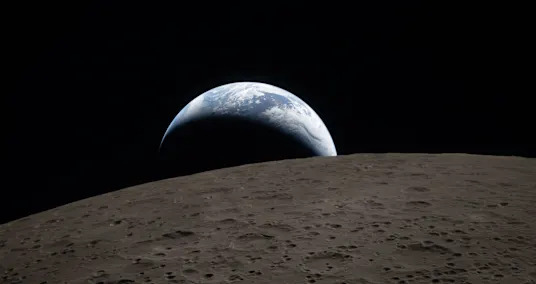
HOUSTON (AP) — The Artemis II astronauts are now forever intertwined with Apollo 8.
A day after the historic lunar flyaround, NASA on Tuesday released striking new photos taken by the U.S.-Canadian crew.
The four astronauts channeled Apollo 8’s famous Earthrise shot from 1968 with their own: Earthset, showing our planet setting behind the gray, pockmarked moon. Another photo captures the total solar eclipse that occurred when the moon blocked the sun from the crew’s perspective.
The three Americans and one Canadian are now headed home, with a splashdown in the Pacific set for Friday. In the meantime, scientists at Houston's Mission Control are poring over the stream of moon photos beaming down.
Apollo 8's three astronauts became the world's first lunar visitors, orbiting the moon on Christmas Eve 1968. Their Earthrise shot became a symbol of the modern-day environmental movement.
Artemis II marks NASA's first return to the moon with astronauts — a critical step toward a lunar landing by another crew in two years.
___
The Associated Press Health and Science Department receives support from the Howard Hughes Medical Institute’s Department of Science Education and the Robert Wood Johnson Foundation. The AP is solely responsible for all content.
LATEST POSTS
- 1
 Palestinians tell BBC they were sexually abused in Israeli prisons
- 2Climate leaders are talking about 'overshoot' into warming danger zone. Here's what it means
- 3A hospital discharged a woman in labor. This lawmaker wants change.
- 4Ultra-Orthodox protests erupt across Israel on haredi IDF enlistment day
- 5Muslim nations condemn new Israeli death penalty law



- Americans generally like wolves − except when we’re reminded of our politics
- Investigate the Excellence of Professional flowerbeds: A Virtual Local escort
- High Court freezes government move to shutter Army Radio pending ruling
- EU-funded BioSupPack project turns brewery waste into bioplastics
- Pick Your #1 Sort Of Espresso
- Figure out how to Detect the Best Rooftop Substitution Choices
- Mysterious bright blue cosmic blasts triggered by black holes shredding stars, scientists say. 'It's definitely not just an exploding star.'
- ONE returns to Red Sea with new service
- Cocaine, caffeine, painkillers consumed by sharks in Bahamas, study finds